Impact of meteorological variations and provisioning on the body condition of feral cattle in a subtropical climate
Format of work:
Journal Article
Event presented at / Journal Name:
Journal of Thermal Biology
Speaker / Contact Author's Name:
Tania Perroux
Speaker / Contact Author's E-mail Address:
tperroux2-c@my.cityu.edu.hk
-
Research aim:
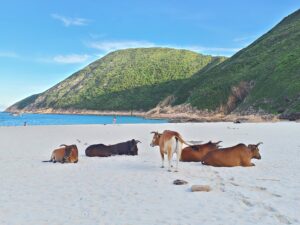
This study assessed how weather, seasonality, and provisioning affect body condition (BCS) in feral cattle in Hong Kong. Over two years, we scored BCS monthly for 262 cattle across 12 herds, using sliding window analysis to identify delayed impacts of meteorological variables. Four herds were provisioned with hay, grass and water by local citizen groups.
-
Background:
Meteorological variations can impact body condition of ungulates over different timescales and populations. The impacts of heat and humidity on body condition, inherent to tropical and subtropical climates, are largely understudied in unmanaged ungulates. In feral ungulates, body condition assessment can help evaluate adaptation to ecological pressures, with some ungulates declining in condition, while other populations thrive in natural habitats.
-
Approach:
We quantified the impact of weather, seasonality and provisioning on body condition in a feral population of cattle (Bos taurus) in Hong Kong. We used an inference method to identify the exact lag between meteorological variations and biological changes (Sliding Windows Analysis). Our study population does not receive routine care but some cattle are provisioned by local people.
-
Key finding:
Cattle maintained good condition (median BCS 5 on a 9‑point scale); extreme scores never occurred. Body condition declined gradually from 2022 to 2024, possibly due to ageing and density dependence. Cloud cover, humidity, sunshine, wind speed and flooding three to four months prior to scoring predicted BCS, indicating seasonal rather than immediate weather effects. Temperature and Temperature-Humidity Index (THI) did not affect BCS at population level, but THI and temperature affected females specifically, not males. Provisioning buffered negative effects of cloud cover, wind speed and flooding. Provisioned cattle showed less BCS variation than non‑provisioned herds, but median BCS was similar (5). Larger herds had lower BCS than smaller herds; males showed greater BCS variation than females.
-
Industry or policy relevance:
The three‑ to four‑month lag between weather variation and body condition change suggests that subtropical feral cattle are well adapted to local seasonality. Provisioning can stabilise body condition but does not eliminate suboptimal scores (BCS 3 occurred even in provisioned herds).
-
Route for practical application:
The findings challenge the universal applicability of THI thresholds developed for production systems, highlighting the need for species‑specific and climate‑specific indicators for free‑ranging ungulates.
-
Confidence in findings and next steps towards realising impact:
The delayed impacts we identified can inform the management of subtropical livestock, and the conservation of wild Asian bovids.
Funders:
This project was funded by City University of Hong Kong (Grant Number 9610496).
Links to Open Access Publications or DOI:
Citation:
Perroux, T. A., McElligott, A. G., Hodgson, G. M. W., & Flay, K. J. (2026). Impact of meteorological variations and provisioning on the body condition of feral cattle in a subtropical climate. Journal of Thermal Biology 139, 104472. https://doi.org/10.1016/j.jtherbio.2026.104472