Seasonal changes in coat colour and sexual size dimorphism in a subtropical ungulate
Format of work:
Journal Article
Event presented at / Journal Name:
Royal Society Open Science
Speaker / Contact Author's Name:
Tania Perroux
Speaker / Contact Author's E-mail Address:
tperroux2-c@my.cityu.edu.hk
-
Research aim:
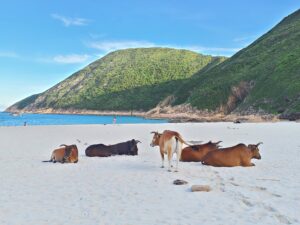
This study investigated phenotypic adaptations in feral cattle in Hong Kong’s subtropical climate, focusing on seasonal coat colour changes and sexual dimorphism in body size and horn length. Over 13 months, we scored coat colour for 253 cattle across 12 herds, and measured body size (five linear measurements) and horn length (compared to ear length) for 317 adult cattle.
-
Background:
Phenotypes reflect the adaptations of organisms to their environments, with common rules defining how coloration and body size should vary based on climate and latitude. Hong Kong (HK) cattle present an opportunity to study these adaptations in one of the very few cattle populations not directly controlled by humans.
-
Approach:
We studied seasonal coat colour changes in HK feral cattle, and sexual dimorphism in body size and horn length.
-
Key finding:
Coat colour changed seasonally: paler coats were more common in the wet season, darker coats in the dry season. Approximately one third of individuals changed coat colour each month. Coat colour was predicted by temperature from the previous month, body condition, wind speed, and solar radiation, supporting the thermal melanism hypothesis (darker coats absorb more solar radiation, beneficial in cooler conditions; paler coats reflect radiation, beneficial in hot, humid conditions). Males were darker, larger, and had longer horns than females. Sexual dimorphism was moderate, consistent with South Asian draught cattle.
-
Industry or policy relevance:
This is the first documented evidence of seasonal coat colour change in cattle. The findings suggest that thermoregulation costs drive colour plasticity, with darker coats imposing higher costs (linked to lower body condition). As global temperatures rise, understanding such phenotypic plasticity in subtropical ungulates can inform management and welfare of free‑ranging and domestic cattle.
-
Route for practical application:
The phenotypic plasticity we demonstrate in these subtropical feral cattle improves our knowledge of the adaptations of ungulates to their habitat.
-
Confidence in findings and next steps towards realising impact:
NA
Funders:
This project was funded by City University of Hong Kong (Grant Number 9610496).
Links to Open Access Publications or DOI:
Citation:
Perroux, T. A., McElligott, A. G., Hodgson, G. M. W., & Flay, K. J. (2025). Seasonal changes in coat colour and sexual size dimorphism in a subtropical ungulate. Royal Society Open Science 12, 250379. https://doi.org/10.1098/rsos.250379