Donkey hair cortisol concentrations are associated with carrying heavy load and being beaten at work
Format of work:
Journal Article
Event presented at / Journal Name:
BMC Veterinary Research
Speaker / Contact Author's Name:
Alan McElligott
-
Research aim:
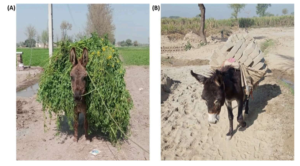
This study investigated the relationship between working conditions and chronic stress in working donkeys in Pakistan. Using owner‑reported data and veterinarian observations, the authors collected information on percent body weight ratio carried (%BWR), presence of skin wounds, lameness, provision of food and water, load type (fodder vs. bricks), and whether donkeys were beaten during work. Hair cortisol concentrations (HCC) were analysed using an ELISA kit, and a multiple linear regression model identified predictors of HCC.
-
Key finding:
High percent body weight ratio (%BWR), being beaten while working, and carrying bricks were all significant predictors of high hair cortisol concentrations. The model explained most of the variance in hair cortisol concentrations (HCC). Almost all donkeys carried loads above recommended limits. The median %BWR was well above safe thresholds. Donkey median body weight was moderate, but median mounted load per trip was substantial, indicating severe overloading. Skin wounds were present in approximately half of donkeys, and lameness in just over half. Only a minority of owners provided food, and just over half provided water during the working day. The study supports the use of HCC as a non‑invasive retrospective measure of hypothalamic-pituitary-adrenal (HPA) axis activity and chronic stress, but emphasises that other stressors (e.g., heavy load, beating) must be considered when interpreting cortisol levels, as cortisol is more closely linked to arousal and HPA activation than to negative affect alone.
-
Industry or policy relevance:
The identification of clear predictors of high HCC provides an evidence‑base for improving working donkey welfare. Exceeding recommended body weight load limits is a critical welfare concern. The association between beating and high HCC underscores the need for owner training, enforcement of humane handling practices, and consideration of load type (brick vs. fodder) when setting weight limits. The authors call for the development of comprehensive loading guidelines and their dissemination within donkey‑owning communities. Further research across different industries (mining, cart pulling, plowing, dairy farming) and regions is recommended. HCC measurement offers practical advantages for field research – samples are non‑invasive, easy to store at room temperature, and provide a retrospective view of stress over months. However, variability due to hair growth rate, anatomical sampling site, and individual differences must be accounted for.
Funders:
This project was funded by the City University of Hong Kong.
Links to Open Access Publications or DOI:
Citation:
Bukhari, S. S. U. H., Li, C. M., Kenéz, A., Steagall, P. V., McElligott, A. G., & Parkes, R. S. V. (2025). Donkey hair cortisol concentrations are associated with carrying heavy load and being beaten at work. BMC Veterinary Research 21, 582. https://doi.org/10.1186/s12917-025-05021-2