Reliability and precision of thermal imaging to assess surface temperature in goats
Format of work:
Journal Article
Event presented at / Journal Name:
PeerJ
Speaker / Contact Author's Name:
Alan McElligott
-
Research aim:
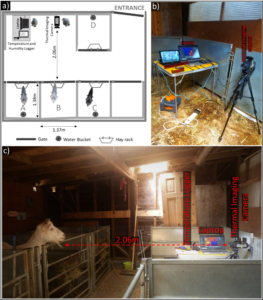
This study evaluated the reliability and precision of infrared thermal imaging for measuring surface temperature in goats. Using video‑recorded thermal footage, the authors extracted mean, maximum, and minimum temperatures from the left eye, right eye, and nose tip of 20 goats over five consecutive days. They assessed short‑term repeatability (within a single session), precision (how much the mean of 1–5 images deviates from the mean of five images), and multi‑day reproducibility (across five sessions).
-
Key finding:
Mean and maximum temperatures were highly repeatable within a single session for all regions of interest, with most variation attributed to differences between individual goats rather than within goats over repeated measures. Minimum temperatures showed lower repeatability and greater variability, making them less reliable. Precision was highest for mean and maximum temperatures; a single image could detect broad differences (e.g., sick vs. healthy), but using multiple images improved precision. Minimum temperatures required many more replicate images to achieve similar precision. When measured across five days, surface temperatures were not readily reproducible, especially for the nose tip, where between‑session effects explained a large proportion of variation. Eye temperatures were more stable but still showed substantial day‑to‑day variation, partly due to changes in ambient conditions and potentially the animals’ internal states. The study therefore recommends avoiding minimum temperature measures in goats and, more generally, in other species. Mean and maximum temperatures are both suitable, but mean eye temperatures and maximum nasal temperatures performed slightly better.
-
Industry or policy relevance:
Thermal imaging is a valuable non‑invasive tool for animal behaviour, welfare, and veterinary research, but its reliability depends strongly on the choice of region of interest and temperature metric. The findings provide evidence‑based guidance for goats and likely applicable to other small ruminants. To increase precision, researchers should average temperatures from multiple images collected in quick succession. For comparing between animals, testing subjects under similar conditions and ideally across multiple sessions is advisable. The high day‑to‑day variability emphasises the need for tight control over environmental factors (ambient temperature, humidity, distance, angle) and for focusing measurements at the individual level when possible.
Funders:
This work was supported by a research grant from Farm Sanctuary (to Alan G. McElligott) for the purchase of a thermal imaging camera, a grant from Ede & Ravenscroft (to Marianne A. Mason), and the Uni
Links to Open Access Publications or DOI:
Citation:
Bhattacharjee, D., Mason, M. A., & McElligott, A. G. (2026). Reliability and precision of thermal imaging to assess surface temperature in goats. PeerJ 14, e20861. https://doi.org/10.7717/peerj.20861