Assessing Perceptions Toward Aquatic Animal Welfare: A Study on the Perspectives of Educators, Students and Aquaculture Industry Stakeholders in South and South-Central Vietnam
Format of work:
Journal Article
Event presented at / Journal Name:
Animals
Speaker / Contact Author's Name:
Sasha Saugh
Speaker / Contact Author's E-mail Address:
sasha@aquaglobalvet.com
-
Research aim:
The aim of the study was to investigate how students, educators, and aquaculture industry stakeholders in Vietnam perceive and understand aquatic animal welfare (AAW). More specifically, the study aimed to identify gaps in knowledge and education at the undergraduate level and to explore how demographic factors and industry priorities influenced perceptions toward AAW. Among students, the study also examined whether there was a correlation between education gap scores and perception scores.
-
Background:
Vietnam is one of the world’s largest aquaculture producers, yet aquatic animal welfare (AAW) governance remains weak, with limited enforcement mechanisms, low penalties, and few species-specific guidelines aligned with WOAH standards. South and South-Central Vietnam account for most of the country’s aquaculture production, making the region important for understanding welfare challenges. Limited tertiary education capacity and misalignment between graduate skills and industry needs may contribute to poor AAW implementation. Despite the importance of aquaculture to Vietnam’s economy, little is known about how students, educators, and industry stakeholders perceive AAW or how education gaps influence welfare-related attitudes and preparedness for reform.
-
Approach:
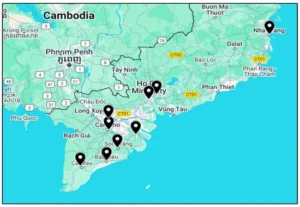
A mixed-methods survey was conducted across universities and colleges in South and South-Central Vietnam to assess perceptions of aquatic animal welfare (AAW) among students, educators, and aquaculture stakeholders. Students completed digital surveys, while educators and stakeholders participated in telephone interviews using validated survey instruments. A weighted, stratified random sampling approach was used for students and educators, while stakeholders were selected through convenience sampling. Surveys examined demographic factors, AAW perceptions, curriculum exposure, and perceived education gaps using Likert-scale and mixed-question formats. Perception and education gap scores were analysed using robust statistical methods in R-Studio to identify trends, group differences, and influencing factors.
-
Key finding:
Vietnam’s aquaculture sector faces a skills and knowledge gap when it comes to aquatic animal welfare (AAW). This study surveyed educators, students, and aquaculture professionals in Vietnam to assess their knowledge and attitudes toward AAW. Institutions still use outdated curricula and have limited resources, leaving graduates poorly equipped to apply AAW in practice. Weak enforcement, low penalties, and a lack of species-specific guidelines, has led to welfare standards being seldom applied. Poor handling, overcrowding, and transport conditions still persist on farms. Financial and cultural priorities often outweigh welfare concerns.
-
Industry or policy relevance:
Existing legislation is largely awareness-driven, with weak penalties, limited enforcement mechanisms, and few species-specific guidelines aligned with WOAH standards. The findings of this study inform national curriculum improvement, support policy development, and provide a model for other countries seeking to align aquaculture practices with international welfare standards. The mismatch between production scale and welfare governance highlights the need to understand how aquaculture stakeholders perceive AAW and how prepared they are to support welfare-focused reforms. The most accepted price premium for higher-welfare aquaculture products among respondents was 6–10%, supporting research showing that moderate mark-ups are the most acceptable for welfare-certified products. Policy support is crucial to institutionalise these reforms. Key priorities include mandating standardised AAW curricula, strengthening educator training, and promoting university–industry collaboration.
-
Route for practical application:
A practical route forward is to strengthen aquatic animal welfare through structured, hands-on education linked directly to farm realities and livelihoods. This includes integrating AAW into aquaculture curricula, expanding field-based learning, internships, case studies, and expert-led workshops, while improving collaboration between universities, industry, and policymakers. Training should focus on helping students and farmers apply welfare principles in daily farm management, transport, handling, and decision-making. Community-based approaches that connect welfare improvements with profitability, food security, sustainability, and human well-being are also essential. Aligning training and policy with international standards such as WOAH can help Vietnam build more ethical, sustainable, and globally competitive aquaculture systems.
-
Confidence in findings and next steps towards realising impact:
The findings provide strong early evidence that aquatic animal welfare awareness exists in Vietnam’s aquaculture sector, but that practical understanding and application remain limited. Confidence in the findings is strengthened by the study’s mixed-methods approach and inclusion of three key groups—students, educators, and aquaculture stakeholders. Consistent patterns observed across these groups, including the gap between awareness and applied competence, suggest that the challenges identified are systemic rather than isolated. The development of the Awareness Depth Gap Framework also provides a useful conceptual model for understanding why welfare awareness does not automatically translate into practice. However, the study relied partly on self-reported perceptions and did not directly measure on-farm behaviour, meaning future research should validate findings through practical assessments and longitudinal studies. The next step toward realising impact is to move from awareness to implementation. This includes piloting structured AAW training programmes with a practical focus, integrating welfare into tertiary curricula, expanding experiential and field-based learning, strengthening university–industry collaboration. Aligning education, policy, and industry incentives with international welfare standards could support more sustainable, ethical, and resilient aquaculture systems.
Funders:
Coefficient Giving
Links to Open Access Publications or DOI:
Citation:
Saugh, S.; Long, P.K.; Trinh, L.-H.; Hoang, O.D.; Kim, H.H.; Day, P.V.; Thi, M.N.; Zacarias, S.; Da, C.T. Assessing Perceptions Toward Aquatic Animal Welfare: A Study on the Perspectives of Educators, Students and Aquaculture Industry Stakeholders in South and South-Central Vietnam. Animals 2026, 16, 26. https://doi.org/10.3390/ani16010026