A critical review on gender differences in attitudes, perceptions, and behaviours about farmed animals
Format of work:
Journal Article
Event presented at / Journal Name:
Applied Animal Behaviour Science
Speaker / Contact Author's Name:
Elisa Cesário Pereira Stadnick
Speaker / Contact Author's E-mail Address:
stadnickelisa@gmail.com
-
Research aim:
This narrative review examined gender differences in attitudes, perceptions, beliefs, empathy, and behaviours related to farmed animals. It synthesised evidence from multiple disciplines and contextualised observed gender differences through sociological, anthropological, and historical perspectives on gendered social roles, the division of labour, and patriarchal structures.
-
Background:
Research has increasingly identified gender as an important factor influencing views on animal welfare and ethics. Although many studies have documented gender differences in attitudes towards animals, these findings have rarely been examined within broader social and historical contexts. This review brings together evidence from diverse fields to better understand why these differences occur and what they mean for farmed animal welfare.
-
Approach:
The authors conducted a narrative review of studies examining gender differences in beliefs about animal sentience, attitudes towards animal use, empathy for farmed animals, consumer behaviour, agriculture, veterinary medicine, and animal welfare science. The evidence was interpreted using sociological, anthropological, and historical perspectives on gender and power relations.
-
Key finding:
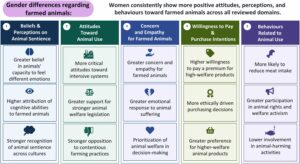
Women consistently show greater concern for farmed animal welfare than men across diverse populations and countries. They are more likely to attribute higher sentience to animals, oppose painful or restrictive farming practices, support stronger animal welfare regulations, and pay for higher-welfare products. These differences are rooted not only in individual attitudes but also in broader gendered social roles, power structures, and historical processes that shape human-animal relationships.
-
Industry or policy relevance:
Animal welfare policies and industry initiatives should recognise that gender influences attitudes, decision-making, and management practices related to farmed animals. Integrating gender perspectives into education, extension services, veterinary practice, and policymaking may strengthen welfare improvements. The review also highlights the importance of addressing gender inequalities in agriculture and promoting more empathetic approaches to animal management.
-
Route for practical application:
The findings support incorporating gender perspectives into animal welfare education, agricultural extension, veterinary training, research, and public policy. Recognising women's contributions and promoting greater inclusion in agricultural decision-making may help translate empathy and care into improved welfare outcomes for farmed animals while encouraging more ethical and inclusive approaches across the sector.
-
Confidence in findings and next steps towards realising impact:
The review synthesises evidence from numerous studies conducted across different countries and populations, showing consistent patterns in gender differences related to farmed animals. Future research should adopt an intersectional perspective, expand studies beyond Western contexts, and investigate how gender-responsive policies and practices can improve outcomes for both women and farmed animals.
Funders:
Coordenação de Aperfeiçoamento de Pessoal de Nível Superior - Brasil (CAPES)
Links to Open Access Publications or DOI:
- https://www.sciencedirect.com/science/article/pii/S0168159126001917
- DOI: 10.1016/j.applanim.2026.107100
Citation:
Stadnick, E. C. P., & Hötzel, M. J. (2026). A critical review on gender differences in attitudes, perceptions, and behaviours about farmed animals. Applied Animal Behaviour Science, 107100. 10.1016/j.applanim.2026.107100