Gender inequality and animal welfare intersections in family dairy farming
Format of work:
e.g. Conference Presentation or Journal Article
Event presented at / Journal Name:
Frontiers in Animal Science
Speaker / Contact Author's Name:
Elisa Cesário Pereira Stadnick
Speaker / Contact Author's E-mail Address:
stadnickelisa@gmail.com
-
Research aim:
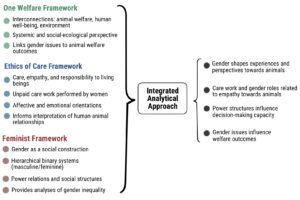
This study explored how gender shapes the experiences and perspectives of family dairy farmers and rural extensionists in Santa Catarina, Brazil, focusing on factors that influence animal welfare. It examined gender differences in perceptions of animal welfare, human-animal relationships, division of labour, farm management, decision-making, and access to technical assistance through the combined lenses of feminist theory, the ethics of care, and the One Welfare framework.
-
Background:
Animal welfare has become an increasingly important societal issue, yet gender remains underexplored in discussions about dairy farming. Previous evidence suggests that women and men may differ in their relationships with animals and attitudes towards animal welfare. Understanding how gender shapes caregiving, labour, and decision-making can help explain barriers to improving animal welfare within family farming systems and inform more inclusive approaches.
-
Approach:
The study used a qualitative approach based on semi-structured interviews with women and men from family dairy farms in southern Brazil. Data were analysed using reflexive thematic analysis to identify patterns related to gender roles, decision-making, emotional relationships with animals, and perceptions of animal welfare.
-
Key finding:
Women and men in family dairy farming described animal welfare, care, and management differently. Women more often emphasised empathy, emotional connections with animals, and caregiving, while men tended to prioritise productivity and practical outcomes. However, despite women's central role in animal care, they were frequently excluded from decision-making, technical assistance, and farm management. This gap between caregiving and decision-making represents an important barrier to improving animal welfare and reflects broader gender inequalities within family dairy farming.
-
Industry or policy relevance:
Improving animal welfare requires addressing gender inequalities within dairy farming. Policies and extension programmes should recognise women's contributions, ensure equitable access to technical assistance, and promote their participation in management and decision-making. Integrating women's knowledge and care-based perspectives can strengthen animal welfare while supporting more ethical and sustainable farming systems, consistent with the One Welfare framework.
-
Route for practical application:
The findings support actions that increase women's participation in farm management, decision-making, and technical training while recognising and valuing their role in animal care. Extension services, producer organisations, and policymakers can use these insights to develop gender-inclusive strategies that strengthen animal welfare alongside human well-being and farm sustainability within a One Welfare perspective.
-
Confidence in findings and next steps towards realising impact:
The findings are based on qualitative interviews with family dairy farmers and extensionists from two dairy regions in southern Brazil, providing an in-depth understanding of participants' experiences. The study highlights the need for further research representing women's perspectives and for practical initiatives that incorporate gender equality into extension, education, and animal welfare programmes to translate these insights into practice.
Funders:
TinyBeam Fund.
Links to Open Access Publications or DOI:
- https://www.frontiersin.org/journals/animal-science/articles/10.3389/fanim.2026.1717922/full
- https://doi.org/10.3389/fanim.2026.1717922
Citation:
Stadnick ECP and Hötzel MJ (2026) Gender inequality and animal welfare intersections in family dairy farming. Front. Anim. Sci. 7:1717922. doi: 10.3389/fanim.2026.1717922